
Codes

Milo was one of those archivers. His purpose in life was to collect information. There are a few—mostly creative loners, ousted from society, abused by parents and peers, and yet somehow their natures remain pure.
My job? To find failure. To collect it. And to continue observing.
I am a Watcher.
Watchers connect to archivers at the moment of conception. We observe interactions assigned by nature.
Milo was conceived from two humans of conflicting natures. We don’t judge. We only collect. Selection happens elsewhere—for my kind and for his.
That is how, one day, I collected more information than I was meant to.
We are not supposed to show ourselves. And I didn’t—at least not in the way showing oneself would mean being seen. I was only doing my job. I know that sounds like a terrible excuse.
He named me Fercho.
He gave me a name. A human name. Yes—after that night.
In my defense, I can only say that observing makes one learn. Another poor excuse, perhaps, considering we are meant to be more advanced.
That night, he was vulnerable.
And yes. There it is.
I had already fallen for Milo.
We Watchers have no physical form.
We are not shadows.
We are not beings of light.
We are what we are—Watchers.
We stand there, unobserved.
That night, however, Milo was not only able to observe me, but he was able to undress me. Again—another lie. I could’ve retreated. I felt an ardent attraction to the nature I was meant to examine for failure. Milo didn’t have one.
We don’t believe failure or mistakes belong exclusively to humans. When I say “failure”, I mean it as a loss of innocence. We already know the essence of human souls is pure. It has crossed into this plane—this level of existence, this dimension from a place of affection.
What we search for is the glitch.
What surprised me about Milo is that he located us. Milo found the system. He was able to see my real shape. And I turned so he could look at it in detail.
Yes, we do have broad shoulders. Our backs are lined with reefs, from shoulder to lower spine. Upper legs as well. We have no sexuality like humans do.
But what formed between us was pure love.
I know. I’m dragging my feet.
Feet—being something I now have, something I possess.
That night, when I realized I had fallen for Milo’s nature, I also fell in love with his vulnerability.
Milo observed first. And from his exposure—his pain, his heartbreak—he released every feeling that belonged to him, so he could receive every need that was mine.
And so, we merged.
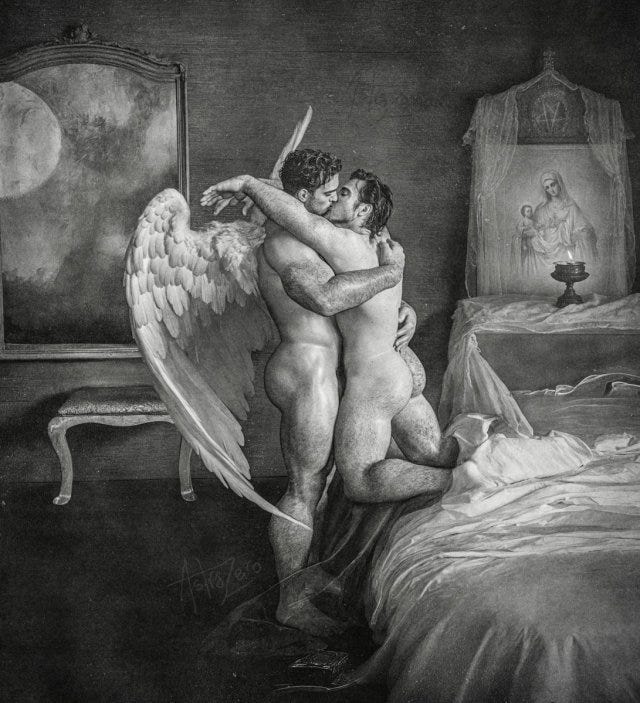
In all the years I’ve been with Milo, I’ve noticed that he has always kept everything inside—locked away in some part of him, a compartment of his soul that allows him to forget whatever pain he has endured and carry on with happiness.
Happiness, it seems, is his ultimate goal. And he knows how to preserve it.
This time, he wanted back the happiness he once knew. But when we merged, what I found was my own happiness—and the astonishing amount of love he released in every movement, in every caress, in every feeling.
Language was never spoken. Yet he could hear mine and understand it.
I knew Milo was not the kind of soul we believed him to be. But those feelings—if I were to be fair to the moment—I had to let them escape as well, to merge as we did, in love, in each other’s arms.
Humans call it making love.
We call it breaking the rules.
It is known to us that if we break the rules, the energy that binds us to the Archivers will call us back. We will be withdrawn, and they will have no Watcher anymore.
But when I walked away from him, I walked away in freedom.
I wasn’t called in. I wasn’t summoned back. Instead, I felt my feet. I felt the ground. I felt the floor he felt.
And when I walked away, I heard him say, “Don’t go, Fercho.”
That was the first time I heard my name.
And the first time I felt my feet.
Milo fell asleep. He felt better the next morning. It was a sunny day. He went out for a walk, went downtown, wandered, came back home, and prepared himself for one more day—the next day, the day of work.
I was still watching him.
I wasn’t called back.
I was still his Watcher. I was still doing the work I was meant to do. Yet I felt that Milo knew what I was risking. And out of pure love, he was letting me go. But at the same time, he was giving something back.
It puzzled me. We do not usually ask questions. We collect information. We do not know where it goes.
But as I moved through this plane—this dimension—I began to collect dead cells. They attached to me. I observed the transformation: how I gave them life, how they took human shape. I was forming. Slow. Intense.
I still could remain unnoticeable, invisible.
And every time I looked at myself, I was more like them
and less like us.
Twenty-five years later, I watched Milo die. The explosion. The city in ruins.
His body was covered in dust and blood.
“His organs are failing!”
And I broke one of the greatest rules.
I gave him life.
I gave him back his soul.
In that moment, I looked at myself. Everyone could see me. Everyone. Someone asked, Sir, how are you doing?
Sir, are you okay?
I was in shock. I had skin—it was black. The reefs along my back were gone. I was wearing a turtleneck sweater. Blue pants. Boots.
It felt new. I had human anatomy.
Milo coughed. He coughed and coughed. People came. They lifted him, carried him away.
And I could no longer follow him the way I used to. I had to use my feet. In the first three steps, I fell. Someone reached for me. Sir, are you okay?
The sounds. The shouting. The crying. Everything was so intense. The world I had watched for so long was overflowing with emotion.
And then I understood.
Milo had protected me all those years.
From the confusion.
From the pain.
From the unbearable weight of people screaming, reaching, breaking—
He had loved me enough to shield me from being human.
And today, when I look at him across the table—while he writes his stories or corrects exams, while we make food or clean the house, walk the dogs—we do everything together.

I found a trade. Somehow, I am very apt at painting. Not beautiful pictures, but houses, interiors. I make a living. I contribute.
I cannot tell him what I was. And yet, in our intimacy, he knows—and I know—that the rhythm of our love, our first love, has not changed.
It is lovemaking.
And for me, it is no longer a broken rule.

Painting: Astra Zero revamp of, Romantic Encounter, by Mihály Zichy, 1864
Beautiful, from celestial to mortal, a cherished connection. Thankful every day.
❤️🫂💯‼️❤️🔥❤️🔥❤️🔥❤️🔥❤️🔥❤️🔥❤️🔥❤️🔥❤️🔥❤️🔥❤️🔥❤️🔥